
About

This is default featured slide 1 title

Go to Blogger edit html and find these sentences.Now replace these sentences with your own descriptions.

This is default featured slide 2 title

Go to Blogger edit html and find these sentences.Now replace these sentences with your own descriptions.

This is default featured slide 3 title

Go to Blogger edit html and find these sentences.Now replace these sentences with your own descriptions.

This is default featured slide 4 title

Go to Blogger edit html and find these sentences.Now replace these sentences with your own descriptions.

This is default featured slide 5 title

Go to Blogger edit html and find these sentences.Now replace these sentences with your own descriptions.

Selasa, 10 Mei 2016

hyponym

What are "Hypernyms and Hyponyms"?


Hyponymy is a relation of inclusion between a hyponym and a hypernym or superordinate. The hyponym includes the meaning of the hypernym, which is the more general word. Generally, the relationship can be described in the terms Hyponym IS A Hypernym.
Hyponymy shows the relationship between the more general terms (hypernyms) and the morespecific instances of it (hyponyms). A hyponym is a word or phrase whose semantic field is more spcific than its hypernym. The semantic field of a hypernym, also known as a superordinate, is broader than that of a hyponym. An approach to the relationship between hyponyms and hypernyms is to view a hypernym as consisting of hyponyms. This, however, becomes more difficult with abstract words such as imagine, understand and knowledge. While hyponyms are typically used to refer to nouns, it can also be used on other parts of speech. Like nouns, hyponyms in verbs are words that refer to a broad category of actions. For example, verbs such as stare, gaze, view and peer can also be
considered hyponyms of the verb look.

Relationship between hypernym and hyponym is termed as ‘is-a relationship’.
Pattern:
Hyponym + is-a/an + Hypernym
Example 1:
Hypernym: game
Hyponym: cricket, football, hockey
Cricket is a game.
Football is a game.
Hockey is a game.
Example 2:
Hypernym: bird
Hyponym: eagle, peacock, sparrow
Eagle is a bird.
Peacock is a bird.
Sparrow is a bird.


Sabtu, 07 Mei 2016

SYNONYM, ANTONYM AND HYPONYM

SYNONYM

*Synonyms are words that have the same or very similar meaning. All words can have a         synonym. Nouns, verbs, adjectives, adverbs and prepositions can have a synonym as long as both words are the same part of speech.

*Synonyms can be any part of speech (e.g. nouns, verbs, adjectives, adverbs or prepositions), as long as both members of the pair are the same part .
*synonym - two words that can be interchanged in a context are said to be synonymous relative to that context
*words or phrases which have similar meaning.

Examples of Synonyms
Adjectives: beautiful, lovely, gorgeous, stunning, striking
Nouns: House, home, dwelling, residence, abode, quarters
Verbs: jump, bound, leap, hop, skip
Prepositions: in, inside, within
Is the state or phenomenon in which the words that sound different, but have the same or identical meaning, as another word or phrase. All words can have a synonym. Nouns, verbs, adjectives, adverbs and prepositions can have a synonym as long as both words are the same part of speech.

Examples of Synonyms
Adjectives: beautiful, lovely, gorgeous, stunning, striking
Nouns: House, home, dwelling, residence, abode, quarters
Verbs: jump, bound, leap, hop, skip
Prepositions: in, inside, within
- See more at: http://shellashintaaclaudia.blogspot.co.id/2016/04/synonimantonym-and-hyponim.html#sthash.RXk8eOnB.dpuf


*Synonyms of Small
  Little, Mini, short, dimunitive, tiny, fine, petite
*Synonyms of Soft
  Downy, silky, dull, low, weak, spongy, limp, malleable
*Synonyms of Wet
  Moist, watery, soppy, soggy, drenched, awashed
*Synonyms of Weak
  Wimpy, sapped, faint, soft, flimsy
*Synonyms of Long
  Elongated, lengthy, outstretched, extended
*Synonyms of Create
  Cause, make, construct
*Synonyms of Hold
  Cling, Clench, Wait, Grip, grasp, clasp
*Synonyms of Run
  Dash, Gallop, Sprint, Scuttle
*Synonyms of Jump
  Leap, Bounce, Hop, Vault, Spring
*Synonyms of Smile
  Beam, Grin


Antonym

*are pairs or groups of words that are notionally opposite in meaning, such as night/day, boy/girl, long/short, hot/cold, etc. This post describes the four categories of antonyms that feature in the use of English, explains the characteristics of each and offers a number of examples of each type.

*Antonyms are words that have opposite meanings. For example, the antonym of long is short. Often words will have more than one antonym but as with synonyms it depends on the context. For instance, the word warm could have the antonym cool or chilly. In order to choose the correct antonym, you have to look at all the meanings and how the word is used. Cool can mean stylish as well as chilly so the word cool may not be the best choice.

Working with Antonyms

Sometimes you need to take  steps to enlarge your findings when doing antonym research:
* Search for the antonyms for a word.
Here is an example of antonyms for the word "good"
  • bad, badly, badness, evil, evilness, ill, malevolent, malicious, poorly, wicked 

Adding a Prefix

Sometimes, an antonym can be easily made by adding a prefix.
Examples of antonyms that were made by adding the prefix “un” are:
  • Likely and unlikely
  • Able and unable
  • Fortunate and unfortunate
  • Forgiving and unforgiving
By adding the prefix “non” you can make these pairs:
  • Entity and nonentity
  • Conformist and nonconformist
  • Payment and nonpayment
  • Combatant and noncombatant
Lastly, adding the prefix “in” can make the following pairs:
  • Tolerant and intolerant
  • Decent and indecent
  • Discreet and indiscreet
  • Excusable and inexcusable

Antonyms can be defined as follows:

1. Gradable (large/small, hot/cold, delicious/disgusting)

Gradable antonyms are typically pairs of adjectives that can be qualified by adverbs such as very, quite, extremely, etc. So for example, we can say the tickets were expensive or the tickets were cheap. However, as expensive and cheap are gradable antonyms, we can also qualify how expensive or cheap they were:
The tickets were surprisingly expensive. The tickets were very expensive. The tickets were quite expensive.
The tickets were incredibly cheap. The tickets were rather cheap. The tickets were undeniably cheap.
Further examples of gradable antonyms are:
  • friendly/unfriendly
  • hot/cold
  • wet/dry
  • interesting/boring
  • bright/dull
  • modern/old-fashioned
  • bland/delicious


2. Complementary (black/white, boy/girl, alive/dead)

Complementary antonyms are pairs of words that are opposite in meaning, cannot be graded and are mutually exclusive. That is, they can exist independently of each other. For example, there might be a daughter in a family but not the complementary opposite of a son, as girls can exist without their complementary opposite of boys.
Further examples of complementary opposites are:
  • push/pull
  • right/wrong
  • yes/no
  • exit/entrance
  • treat/punishment
  • silence/noise
  • lift/drop

3. Converse (teacher/student, doctor/patient, defence/prosecution)

Converse antonyms are pairs of opposites where one cannot exist without the other. For example to have a husband, you must have a wife. Therefore, husband and wife are complementary antonyms.
Further examples of complementary antonyms are:
  • borrow/lend
  • parent/child
  • above/below
  • night/day
  • policeman/criminal
  • husband/wife
  • plug/socket


Word Synonym antonyms Example Sentences
big large small He has a big house in California.
She has a small apartment in Manhattan.
difficult, hard easy The test was very difficult,.
I think riding a bike is easy.
new recent used I bought a recent book.
She drives a used car.
clean tidy dirty He keeps his house tidy.
The car is dirty and needs to be washed.
Deposit secure dangerous The money is secure in the bank.
Walking through downtown at midnight is dangerous.
friendly outgoing unfriendly Tom is outgoing with everyone.
There are many unfriendly people in this town.
good great bad That's a great idea!
He's a bad tennis player.
cheap inexpensive expensive Homes are inexpensive at the moment.
That car is very expensive.
interesting fascinating boring That's a fascinating story.
That TV show is boring.
quiet still noisy It's nice and still in this room.
The children are very noisy today.
Nouns: Beginning to Intermediate Levels
Word Synonym antonyms Example Sentences
student pupil teacher The pupils are in their seats.
The teacher Began the class.
owner director employee The director hired three new people.
The employees are very happy with Reviews their jobs.
earth ground water The ground here is very rich.
You need water to live.
day daylight night It's daylight out. Get up!
I usually go to bed early at night.
answer response question What is your response?
She asked him a number of questions.
beginning start end The start is at 8 am.
The end of the book is very good.
man male woman Tim is a male.
Jane is a woman.
dog puppy paint I'd like to get a puppy.
The cat meowed so I let her in the house.
food cuisine drink Let's eat some French cuisine tonight.
She had a drink after work.
boy lad girl The lad is waiting for you in the other room.
There are four girls in the class.
Adverbs: Intermediate
Word Synonym antonyms Example Sentences
fast quickly intervening slowly He drives very quickly intervening.
I slowly walked through the park.
carefully cautiously carelessly Tim walked cautiously through the room checking everything.
Those who drive carelessly will probably have an accident.
always all the time never She easts lunch at her desk all the time.
She never goes to the dentist.
seriously thoughtfully thoughtlessly He thoughtfully answered the the question.
She speaks about her private life thoughtlessly.
colorfully plainly brightly She painted the picture plainly.
He spoke about his adventures brightly.

collocation

COLLOCATION


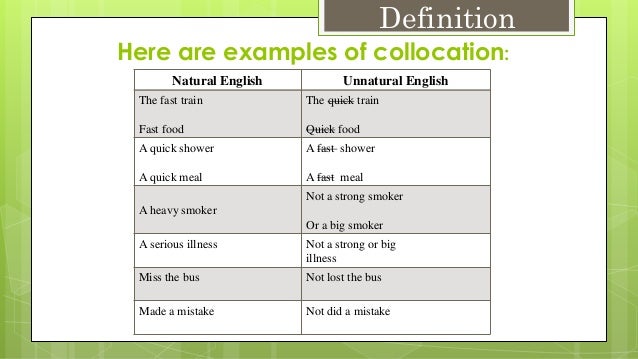
A collocation is a group of words that usually go together. For example, in English, we usually say 'heavy rain'. It's correct grammatically to say 'strong rain' or 'big rain', but both of these sound completely strange. A native English speaker would never say 'big rain'. If you use the normal collocation ('heavy rain') your English will sound a lot better and more natural and it will be easier for native speakers to understand you. Collocations are very, very important.
It's very difficult to give a list of collocations, because there are so many. In fact, almost every word in English has other words that it usually goes with.


    Example Collocations
    There are several different types of collocation. Collocations can be adjective + adverb, noun + noun, verb + noun and so on. Below you can see seven main types of collocation in sample sentences.


    EXAMPLE
    • Adverb + Adjective : completely satisfied (not downright satisfied)
    • Adjective + Noun : excruciating pain (not excruciating joy)
    • Noun + Noun : a surge of anger (not a rush of anger)
    • Noun + Verb : lions roar (not lions shout)
    • Verb + Noun : commit suicide (not undertake suicide)
    • Verb + Expression with Preposition : burst into tears (not blow up I tears)
    • Verb + Adverb : wave frantically (not wave feverishly)

    1. adverb + adjective
    • Invading that country was an utterly stupid thing to do.
    • We entered a richly decorated room.
    • Are you fully aware of the implications of your action?
    2. adjective + noun
    • The doctor ordered him to take regular exercise.
    • The Titanic sank on its maiden voyage.
    • He was writhing on the ground in excruciating pain.
    3. noun + noun
    • Let's give Mr Jones a round of applause.
    • The ceasefire agreement came into effect at 11am.
    • I'd like to buy two bars of soap please.
    4. noun + verb
    • The lion started to roar when it heard the dog barking.
    • Snow was falling as our plane took off.
    • The bomb went off when he started the car engine.
    5. verb + noun
    • The prisoner was hanged for committing murder.
    • I always try to do my homework in the morning, after making my bed.
    • He has been asked to give a presentation about his work.
    6. verb + expression with preposition
    • We had to return home because we had run out of money.
    • At first her eyes filled with horror, and then she burst into tears.
    • Their behaviour was enough to drive anybody to crime.
    7. verb + adverb
    • She placed her keys gently on the table and sat down.
    • Mary whispered softly in John's ear.
    • I vaguely remember that it was growing dark when we left.


    example 

    Strong tea (not Powerful tea/coffee)
    Tall Tree (not High Tree)
    Heavy Rain (not Weighty rain)
    Rich taste (not Deep Taste)
    Big Mistake (not Large mistake)
    Great fun (not Big fun)


     https://www.englishclub.com/vocabulary/collocations-samples.htm


    Sabtu, 23 April 2016

    Ambiguity

    Ambiguity
     
     
    Ambiguity is a type of uncertainty of meaning in which several interpretations are plausible. It is thus an attribute of any idea or statement whose intended meaning cannot be definitively resolved according to a rule or process with a finite number of steps. (The ambi- part of the name reflects an idea of "two" as in two meanings.)
    The concept of ambiguity is generally contrasted with vagueness. In ambiguity, specific and distinct interpretations are permitted (although some may not be immediately apparent), whereas with information that is vague, it is difficult to form any interpretation at the desired level of specificity.
    Context may play a role in resolving ambiguity. For example, the same piece of information may be ambiguous in one context and unambiguous in another.


    The lexical ambiguity of a word or phrase pertains to its having more than one meaning in the language to which the word belongs. "Meaning" here refers to whatever should be captured by a good dictionary. For instance, the word "bank" has several distinct lexical definitions, including "financial institution" and "edge of a river". Another example is as in "apothecary". One could say "I bought herbs from the apothecary". This could mean one actually spoke to the apothecary (pharmacist) or went to the apothecary (pharmacy).
    The context in which an ambiguous word is used often makes it evident which of the meanings is intended. If, for instance, someone says "I buried $100 in the bank", most people would not think someone used a shovel to dig in the mud. However, some linguistic contexts do not provide sufficient information to disambiguate a used word.
    Lexical ambiguity can be addressed by algorithmic methods that automatically associate the appropriate meaning with a word in context, a task referred to as word sense disambiguation.
    The use of multi-defined words requires the author or speaker to clarify their context, and sometimes elaborate on their specific intended meaning (in which case, a less ambiguous term should have been used). The goal of clear concise communication is that the receiver(s) have no misunderstanding about what was meant to be conveyed. An exception to this could include a politician whose "weasel words" and obfuscation are necessary to gain support from multiple constituents with mutually exclusive conflicting desires from their candidate of choice. Ambiguity is a powerful tool of political science.
    More problematic are words whose senses express closely related concepts. "Good", for example, can mean "useful" or "functional" (That's a good hammer), "exemplary" (She's a good student), "pleasing" (This is good soup), "moral" (a good person versus the lesson to be learned from a story), "righteous", etc. " I have a good daughter" is not clear about which sense is intended. The various ways to apply prefixes and suffixes can also create ambiguity ("unlockable" can mean "capable of being unlocked" or "impossible to lock").
    Syntactic ambiguity arises when a sentence can have two (or more) different meanings because of the structure of the sentence—its syntax. This is often due to a modifying expression, such as a prepositional phrase, the application of which is unclear. "He ate the cookies on the couch", for example, could mean that he ate those cookies that were on the couch (as opposed to those that were on the table), or it could mean that he was sitting on the couch when he ate the cookies. "To get in, you will need an entrance fee of $10 or your voucher and your drivers' license." This could mean that you need EITHER ten dollars OR BOTH your voucher and your license. Or it could mean that you need your license AND you need EITHER ten dollars OR a voucher. Only rewriting the sentence, or placing appropriate punctuation can resolve a syntactic ambiguity. For the notion of, and theoretic results about, syntactic ambiguity in artificial, formal languages (such as computer programming languages), see Ambiguous grammar.
    Spoken language can contain many more types of ambiguities which are called phonological ambiguities, where there is more than one way to compose a set of sounds into words. For example, "ice cream" and "I scream". Such ambiguity is generally resolved according to the context. A mishearing of such, based on incorrectly resolved ambiguity, is called a mondegreen.
    Semantic ambiguity happens when a sentence contains an ambiguous word or phrase—a word or phrase that has more than one meaning. In "We saw her duck" (example due to Richard Nordquist), the word "duck" can refer either
    1. to the person's bird (the noun "duck", modified by the possessive pronoun "her"), or
    2. to a motion she made (the verb "duck", the subject of which is the objective pronoun "her", object of the verb "saw").
    For example, "You could do with a new automobile. How about a test drive?" The clause "You could do with" presents a statement with such wide possible interpretation as to be essentially meaningless.[citation needed] Lexical ambiguity is contrasted with semantic ambiguity. The former represents a choice between a finite number of known and meaningful context-dependent interpretations. The latter represents a choice between any number of possible interpretations, none of which may have a standard agreed-upon meaning. This form of ambiguity is closely related to vagueness.
    Linguistic ambiguity can be a problem in law, because the interpretation of written documents and oral agreements is often of paramount importance.


    allomorph and zero allomorph

       Allomorph


    In linguistics, an allomorph is a variant form of a morpheme, that is, when a unit of meaning varies in sound without changing meaning. The term allomorph explains the comprehension of phonological variations for specific morphemes.
    Allomorph is variant form of morpheme about the sounds and phonetic symbols but it doesn’t change the meaning. There are three types of allomorph, phonologically, morphologically and lexically conditioned allomorph.


    1. Phonologically conditioned allomorph
    The choice of allomorph is predictable on the basis of the pronounciation
    • Allomorph of the indefinite article : an (before vowels, ex : an elephant) and a (before consonant, ex : a dog) both of them have meaning one,single.
    • Allomorphs of the regular past tense morpheme
    1. /id/ after d,t : hated
    2. /t/ after all other voiceless sounds : picked
    3. /d/ after all other voiced sounds : wedged
    4. /im/ before bilabial sounds : impossible
    5. /il/ before consonant /l/ : illegal
    6. /in/ elsewhere : independent
    • Some allomorph of the negative prefix in-
    1. Morphologically conditioned allomorph
    The choice of allomorph is determined by particular morphemes, not just by their pronounciation, ex : the morpheme –sume in changes to –sumpt- in (consume = consumption)
    1. Lexically conditioned allomorph
    The choice of allomorph is unpredictable, thus memorized on a word by word basis, ex : ox –plural- oxen, sheep-plural- sheep.
    There are examples of allomorph.
    Example :
    1. Three different allomorphs
      Cats /s/
      Dogs/z/
      Boxes/iz/
    1. One allomoprh
      Disagreement /dis/
      Discount /dis/
      Disbelieve /dis/

          3.Loved /d/
          Two differen  allomorphs
         Voiced /d/
         Walked /t/
         Stopped /t/
         Kicked /t/
    Note : allomorph occur at every morpheme, ex : agree (one morpheme, one allomorph)
    So, allomorph is variant form of a morpheme about the sounds and phonetic symbol but it doesn’t change the meaning. Allomorph has different in pronounciation and spelling according to their condition. It means that allomorph will have different sound, pronounciation or spelling in different condition.


    English has several morphemes that vary in sound but not in meaning. Examples include the past tense and the plural morphemes.
    For example, in English, a past tense morpheme is -ed. It occurs in several allomorphs depending on its phonological environment, assimilating voicing of the previous segment or inserting a schwa when following an alveolar stop:
    • as /əd/ or /ɪd/ in verbs whose stem ends with the alveolar stops /t/ or /d/, such as 'hunted' /hʌntɪd/ or 'banded' /bændɪd/
    • as /t/ in verbs whose stem ends with voiceless phonemes other than /t/, such as 'fished' /fɪʃt/
    • as /d/ in verbs whose stem ends with voiced phonemes other than /d/, such as 'buzzed' /bʌzd/
    Notice the "other than" restrictions above. This is a common fact about allomorphy: if the allomorphy conditions are ordered from most restrictive (in this case, after an alveolar stop) to least restrictive, then the first matching case usually "wins". Thus, the above conditions could be re-written as follows:
    • as /əd/ or /ɪd/ when the stem ends with the alveolar stops /t/ or /d/
    • as /t/ when the stem ends with voiceless phonemes
    • as /d/ elsewhere
    The fact that the /t/ allomorph does not appear after stem-final /t/, despite the fact that the latter is voiceless, is then explained by the fact that /əd/ appears in that environment, together with the fact that the environments are ordered. Likewise, the fact that the /d/ allomorph does not appear after stem-final /d/ is because the earlier clause for the /əd/ allomorph takes priority; and the fact that the /d/ allomorph does not appear after stem-final voiceless phonemes is because the preceding clause for the /t/ takes priority.
    Irregular past tense forms, such as "broke" or "was/ were", can be seen as still more specific cases (since they are confined to certain lexical items, such as the verb "break"), which therefore take priority over the general cases listed above.

    Noun1.allomorph - any of several different crystalline forms of the same chemical compound; "calcium carbonate occurs in the allomorphs calcite and aragonite"
    chemical compound, compound - (chemistry) a substance formed by chemical union of two or more elements or ingredients in definite proportion by weight

    2.allomorph - a variant phonological representation of a morpheme; "the final sounds of `bets' and `beds' and `horses' and `oxen' are allomorphs of the English plural morpheme"
    morpheme - minimal meaningful language unit; it cannot be divided into smaller meaningful units


    zero allomorph


     In morpheme-based morphology, the term null allomorph or zero allomorph is sometimes used to refer to some kind of null morpheme for which there are also contexts in which the underlying morpheme is manifested in the surface structure. It is therefore also an allomorph. The phenomenon itself is known as null allomorphy, morphological blocking or total morpheme blocking.

    A zero, in linguistics, is a constituent needed in analysis but not realized in speech. Specifically in phonology, it refers to an element that is phonologically null. This implies that there is a lack of an element where a theory would expect one. It is usually written with the symbol "∅", . A common ad hoc solution is to use the Scandinavian capital letter Ø instead.
    There are several kind of zeros.
    • A zero morph, consisting of no phonetic form, is an allomorph of a morpheme that is otherwise realized in speech. In the phrase two sheep-∅, the plural marker is a zero morph, which is an allomorph of -s as in two cows. In the phrase I like-∅ it, the verb conjugation has a zero affix, as opposed to the third-person singular present -s in he likes it.
    • A zero pronoun occurs in some languages. In the English sentence nobody knows ∅ the zero pronoun plays the role of the object of the verb, and in ∅ makes no difference it plays the role of the subject. Likewise, the zero pronoun in the book ∅ I am reading plays the role of the relative pronoun that in the book that I am reading. This is also referred to as PRO. In pronoun-dropping languages, including null subject languages such as most Romance languages, the zero pronoun is a prominent feature.
    • A zero subordinate conjunction occurs in English in sentences like I know ∅ he likes me, in which the zero conjunction plays the role of the subordinate conjunction that in I know that he likes me.
    • A zero article is an unrealized indefinite or definite article in some languages.
    • A zero copula,in which a copula such as the verb to be is implied but absent. For example, in Russian the copula is usually omitted in the present tense, as in "Она красивая" (literally: She beautiful), the same happening with colloquial Brazilian Portuguese, as in "irônicos, aqueles" (literally: ironic, those [guys]), though never with the adjective coming after the subject as usual in Romance languages. In English the copula is sometimes omitted in some nonstandard dialects.

    examples
    • cat = cat + -Ø = ROOT ("cat") + SINGULAR
    • cats = cat + -s = ROOT ("cat") + PLURAL
    In addition, there are some cases in English where a null morpheme indicates plurality in nouns that take on irregular plurals.
    • sheep = sheep + -Ø = ROOT ("sheep") + SINGULAR
    • sheep = sheep + -Ø = ROOT ("sheep") + PLURAL
    Also, a null morpheme marks the present tense of verbs in all forms but the third person singular:
    • (I) run = run + -Ø = ROOT ("run") + PRESENT: Non-3rd-SINGULAR
    • (He) runs = run + -s = ROOT ("run") + PRESENT: 3rd-SINGULAR


    Minggu, 10 April 2016

    implication

    implication


    Simple Definition of implication

    • : a possible future effect or result
    • : something that is suggested without being said directly : something that is implied
    : the fact or state of being involved in or connected to something (such as a crime) : the fact or state of being implicated in something


    Full Definition of implication
    1. 1 a :  the act of implicating (see implicate):  the state of being implicated b :  close connection; especially :  an incriminating involvement
    2. 2 a :  the act of implying :  the state of being implied b (1) :  a logical relation between two propositions that fails to hold only if the first is true and the second is false — see truth table table (2) :  a logical relationship between two propositions in which if the first is true the second is true (3) :  a statement exhibiting a relation of implication
    3. 3 :  something implied: as a :  suggestion b :  a possible significance <the book has political implications>
    im·pli·ca·tive play \ˈim-plə-ˌkā-tiv, im-ˈpli-kə-\ adjective
    im·pli·ca·tive·ly adverb
    im·pli·ca·tive·ness noun